
Article Forge Review (2025): AI vs. Manual Writing
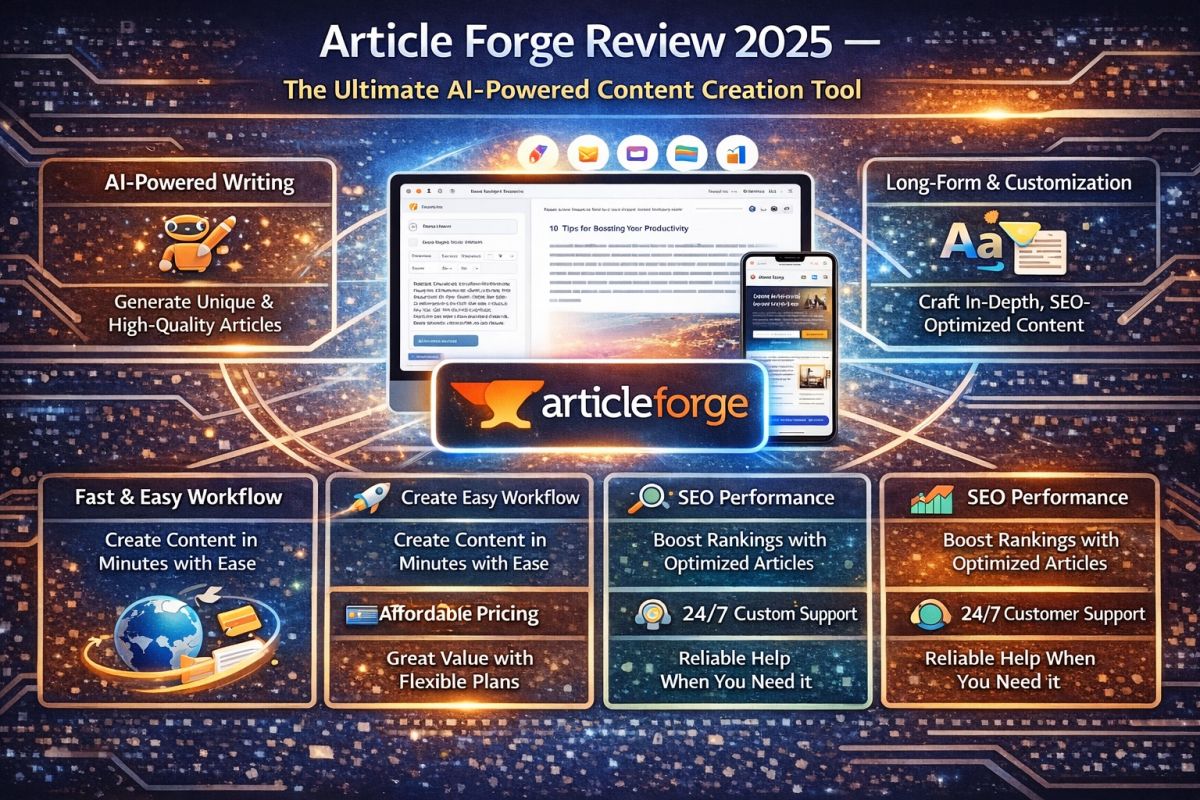
What if publishing high-quality, long-form articles stopped being a bottleneck—and instead became a predictable, scalable system?
That’s exactly where Article Forge positions itself in 2025. Not as another AI writing assistant that helps you “write faster,” but as a fully autonomous article generation engine designed to produce complete, structured content with minimal human input.
In this in-depth review, we take a critical, editorial look at Article Forge: how it works, where it excels, where it still needs refinement, and whether it truly deserves a place in modern SEO-driven content workflows. If your website depends on consistent, SEO-ready content — and you want to publish faster without sacrificing structure — Article Forge is one of the few AI tools that can actually handle full articles end-to-end.
👉 Explore Article Forge here and see how full articles are generated automatically:
What Is Article Forge?
Article Forge is an AI-powered content generation platform built specifically for long-form article creation. Unlike tools that assist with paragraphs, outlines, or sentence rewriting, Article Forge generates entire articles end-to-end based on a primary topic or keyword.
From the introduction to the conclusion, the platform handles structure, flow, and topical relevance automatically. The result is a full article draft that already resembles a publishable blog post rather than a collection of disconnected AI outputs.
This approach makes Article Forge particularly appealing to websites that rely on content volume, topical coverage, and consistency—rather than one-off editorial pieces.
How Article Forge Differs From Typical AI Writers
Most AI writing tools operate as assistants. They wait for instructions, generate short responses, and require continuous prompting to maintain coherence. Article Forge takes a fundamentally different route.
Instead of responding to prompts section by section, it uses deep learning models trained to understand how full articles are structured. When you enter a topic, the system determines subtopics, organizes sections logically, and writes the article as a unified piece.
This distinction matters. It reduces fragmentation, saves editorial time, and produces drafts that already align with how search engines expect informational content to be presented. At this stage, most users realize that Article Forge isn’t designed for writing assistance — it’s built for content production at scale, where speed, structure, and consistency matter more than manual drafting.
👉 This is exactly how Article Forge works in real-world publishing workflows:
Core Features That Define Article Forge
At its core, Article Forge is built for scale—but not at the expense of readability.
The platform generates genuine long-form articles rather than padded text. Each article includes a natural introduction, contextual subheadings, coherent paragraphs, and a closing section that summarizes the topic. This structure makes the content easier to optimize further and easier for readers to follow.
Another notable strength is niche flexibility. Article Forge performs reliably across industries such as technology, marketing, finance, health, SaaS, and e-commerce. This makes it suitable for multi-topic websites or content hubs expanding into new verticals.
The platform also supports multiple languages, which opens the door to international SEO strategies and multilingual content operations. For publishers targeting non-English markets, this feature alone can significantly reduce production friction.
Bulk generation is another area where Article Forge quietly excels. Instead of treating each article as a separate task, users can generate multiple pieces in a single workflow—an advantage for agencies, large blogs, and content networks managing scale.
SEO Performance and Content Readiness
From an SEO standpoint, Article Forge outputs content that is structurally sound but intentionally neutral. The articles are readable, logically organized, and free from obvious duplication patterns, which makes them suitable as a foundation for optimization.
While the AI does not replace human judgment entirely, it significantly reduces the time needed to reach a publishable draft. Editors can focus on refinement—adding internal links, adjusting tone, and aligning content with brand voice—rather than building articles from scratch.
This balance between automation and editorial control is one of Article Forge’s strongest advantages.
Real-World Use Cases
Article Forge is particularly effective for websites where content is a growth lever rather than a branding exercise.
SEO-focused blogs can use it to expand topical clusters efficiently, covering supporting keywords without slowing down production. Affiliate and review-based sites benefit from the ability to generate consistent informational content that supports commercial pages indirectly.
Digital agencies can integrate Article Forge into their workflows to handle baseline content creation while reserving human resources for strategy and quality assurance. Even SaaS companies use it to maintain active blogs without overloading internal teams.
Long-Term Content Scalability & Editorial Control
One of the most overlooked advantages of Article Forge is how it reshapes long-term content strategy.
Instead of content creation being reactive—written only when time allows—it becomes systematic. Article Forge enables publishers to maintain a consistent publishing schedule, which search engines reward over time.
Equally important is editorial flexibility. The generated content is not locked or rigid. It can be expanded, rewritten, or refined easily, allowing teams to layer expertise, insights, and updates without starting from zero.
This makes Article Forge especially suitable for growing platforms like Kytetools.com, where content needs to scale without sacrificing structure or search visibility.
Pricing Overview
Article Forge offers a subscription-based model with multiple usage tiers. New users can explore the platform through a limited trial, while paid plans unlock higher output capacity, faster processing, multilingual generation, and advanced features such as API access.
The pricing structure is designed to accommodate both individual publishers and large-scale operations, making it flexible depending on content volume needs.
Strengths and Limitations
Article Forge’s primary strength lies in its ability to generate full articles autonomously. It saves time, maintains structure, and supports content scaling better than most AI writers in its category.
That said, it is not a replacement for human editorial judgment. Certain topics still benefit from manual refinement, especially when tone, nuance, or original insights are required. Visual content creation is also outside its scope, meaning it works best alongside complementary tools. If you’re serious about scaling content without burning time or editorial resources, Article Forge is worth experiencing firsthand.
👉 See how Article Forge generates complete long-form articles from a single topic:
Final Verdict: Is Article Forge Worth Using in 2025?
Article Forge stands out because it does not try to mimic human creativity—it focuses on efficiency, structure, and scalability.
For publishers who understand that AI content works best as a foundation rather than a final product, Article Forge is a powerful asset. It transforms content production into a repeatable system, freeing teams to focus on optimization, strategy, and growth.
In 2025, where content velocity and consistency matter more than ever, Article Forge earns its place among the most practical AI writing platforms available today.
FAQ Schema
What is Article Forge and how does it work?
Article Forge is an advanced AI content generation tool designed to create full-length articles automatically. Unlike basic AI writers that generate short sections or paragraphs, Article Forge produces complete articles with introductions, headings, structured paragraphs, and conclusions based on a single topic or keyword.
Is Article Forge suitable for large-scale content production?
Yes. Article Forge is specifically built for content scalability. It is widely used by SEO teams, niche site builders, content networks, and agencies that need to publish large volumes of structured articles efficiently without manual writing.
Can Article Forge create SEO-friendly articles?
Article Forge generates articles with natural structure, topic relevance, and readable flow, making them suitable for SEO-focused websites. While the content is well-structured, advanced SEO optimization such as internal linking and SERP targeting can further improve performance.
Does Article Forge support multiple languages?
Yes. Article Forge supports content generation in multiple languages, which makes it a strong option for international websites, multilingual blogs, and global SEO strategies.
Is the content generated by Article Forge unique?
Article Forge creates original content using deep learning models. The generated articles are designed to be unique and suitable for publishing, though light editorial review is recommended for tone refinement or niche-specific accuracy.
Who should use Article Forge?
Article Forge is ideal for SEO bloggers, affiliate site owners, SaaS companies, digital publishers, and agencies that rely on consistent content output. It is especially useful for projects where speed, scale, and structure matter more than manual drafting.
Can beginners use Article Forge easily?
Yes. Article Forge is beginner-friendly and requires minimal setup. Users only need to input a topic and basic preferences to generate a complete article, making it accessible even for those without prior content writing experience.
How does Article Forge compare to traditional AI writers?
Traditional AI writers assist with sections or ideas, while Article Forge focuses on full article automation. It is designed to replace manual drafting workflows rather than assist with isolated writing tasks.